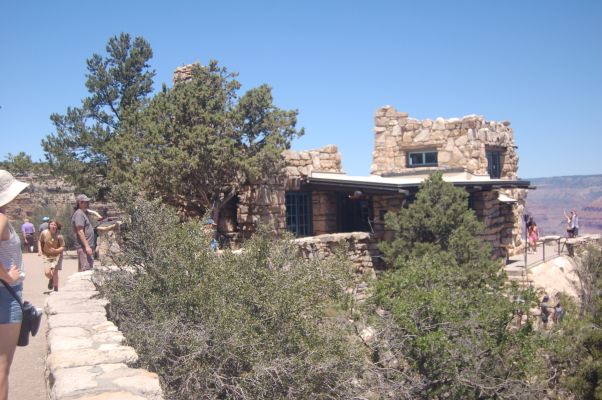
Monday, July 29 2024: … Two Minutes After The THIRD Previous Photo, That Showed View After, Walking Further West Along The Stone Wall,
…We Catch Sight Of Mary Jane Colter’s, Lookout Studio At Grand Canyon, 1914.
… Colter’s Studio Perched On A Clif Edge, Is Marvelously Blended With The Surrounding Rocks!
********************
A Pioneering Woman WebSite => Has Ten Photos Of Mary Colter’s Buildings, Most Notably 2 Historic Photos Of Her Lookout Studio At Grand Canyon, Plus A Historic Photo Of Her In Box Of Rocks To Be Crane Hook Hoisted. …. Plus Much Information, Internet Links, and A Complete Bibliography. Mary Colter's: A National Park Service Page With 8 Photos, 3 Of Which Are, Including One Photo Of Mary Colter. Click Here..
To REPEAT Previous Captions, A NPS Page Says =>
…Mary Elizabeth Jane Colter (1869–1958) was an American architect and interior designer whose distinct architectural style was steeped in the imagery, culture, and landscape of the Southwest. As the primary architect for the Fred Harvey Company, she designed hotels, shops, and rest areas along one of the major routes of the Atchison, Topeka, and Santa Fe Railway from 1902 until her retirement in 1948. Colter’s most well-known projects include the buildings she created in Arizona’s Grand Canyon National Park—the Hopi House, Hermit’s Rest, Lookout Studio, and Desert View Watchtower—all of which demonstrate a commitment to regionally appropriate, site-specific architecture and to a desire to integrate Native American construction techniques and design motifs within her work. include the buildings she created in Arizona’s Grand Canyon National Park—the Hopi House, Hermit’s Rest, Lookout Studio, and Desert View Watchtower—all of which demonstrate a commitment to regionally appropriate, site-specific architecture and to a desire to integrate Native American construction techniques and design motifs within her work. ,,,,
… From 1902 through 1948, Colter served as the primary architect and designer for the Fred Harvey Company, completing twenty-one hotels, curio shops, and rest areas along one of the major routes of the Atchison, Topeka, and Santa Fe Railway—architecture that, despite its inherent commercial purpose, transcended the kitsch of a burgeoning tourism industry to capture the mystery and romance of the American Southwest. Some characteristic features of her designs were tiny windows allowing shafts of light to accent red sandstone walls; a low ceiling of saplings and twigs resting on peeled log beams; a hacienda enclosing an intimate courtyard; a rough boulder structure, built into the earth as if part of a natural rock formation. These details shaped American visions of the Southwest for generations to come.
…All twenty-one of Colter’s projects reveal her acute understanding of and commitment to both the natural and cultural landscape in which she worked, as well as an adaptable, multifaceted aesthetic. Through her interior designs, Colter demonstrated a spirited irreverence in her compositions, offering a clever demonstration of her own inventive Arts and Crafts sensibility; for example, in the Indian Building and Museum adjacent to the Hotel Alvarado (1902), she situated Native American crafts within a turn-of-the-century domestic framework through a lively pastiche of exotic artifacts, salable handicrafts, and Mission-style furniture. ,,,,
…Other Fred Harvey Company projects drew Colter away from the Grand Canyon, giving her the opportunity to design station-hotels along the Sante Fe Railway line, through which her architectural vision could manifest at a greater scale. Of the El Navajo Hotel in Gallup, New Mexico (1923), she mused, “I have always longed to carry out the true Indian idea, to plan a hotel strictly Indian with none of the conventional modern motifs.” Colter, quoted in the New Mexico State Tribune, May 25, 1923, in Claire Shepherd-Lanier, “Trading on Tradition: Mary Jane Colter and the Romantic Appeal of Harvey House Architecture,” Journal of the Southwest 38, no. 2 (Summer, 1996): 183. probably referring to the ersatz Native Americana common to so many of the inferior hotels arising in the Southwest after World War I. Both the El Navajo and La Posada (1930) hotels (in Gallup, New Mexico, and Winslow, Arizona, respectively), demonstrated Colter’s engagement with regional design issues and evoked the originality and wit of her earlier projects.
… Frank Waters, the great historian and expert on Native Americans of the Southwest, in his book Masked Gods: Navaho and Pueblo Ceremonialism (1950), recalled Mary Jane Colter as “an incomprehensible woman in pants” riding horseback, sketching ruins, and meticulously studying construction details.
…Although her contemporaries often called her a “decorator,” her projects, of which four—Hopi House, Hermit’s Rest, Lookout Studio, and Desert View Watchtower—have been designated National Historic Landmarks, suggest that “architect” would be a more accurate and enduring description.
File = DSC 0475 Resize602x400