|
|
Gallery: Photos Illustrate Pirsig's "Zen Art Motorcycle Maintenance"  Album: In This Photo Album, You Will See Views Of David Matos July 2024 Travel, In San Francisco, CA.
… And Then On Their Way Home To Aiken, SC => Visit Stutter's Fort In Sacramento, CA, Non-Stop Thru Las Vegas & Lake Mead. Photo Time At Bolder Dam (Hover Dam), Plus The REALLY Grand Canyon. & Brief Stop At Meteor Crater:
Album: Album: In This Photo Album, You Will See Views Of David Matos July 2024 Travel, In San Francisco, CA.
… And Then On Their Way Home To Aiken, SC, Visit Stutter's Fort In Sacramento, CA, Non-Stop Thru Las Vegas & Lake Mead. Photo Time At Bolder Dam (Hover Dam), Plus The REALLY Grand Canyon. & Brief Stop At Meteor Crater.
Album: In This Photo Album, You Will See Views Of David Matos July 2024 Travel, In San Francisco, CA.
… And Then On Their Way Home To Aiken, SC => Visit Stutter's Fort In Sacramento, CA, Non-Stop Thru Las Vegas & Lake Mead. Photo Time At Bolder Dam (Hover Dam), Plus The REALLY Grand Canyon. & Brief Stop At Meteor Crater:
Album: Album: In This Photo Album, You Will See Views Of David Matos July 2024 Travel, In San Francisco, CA.
… And Then On Their Way Home To Aiken, SC, Visit Stutter's Fort In Sacramento, CA, Non-Stop Thru Las Vegas & Lake Mead. Photo Time At Bolder Dam (Hover Dam), Plus The REALLY Grand Canyon. & Brief Stop At Meteor Crater.
|
|
|
|
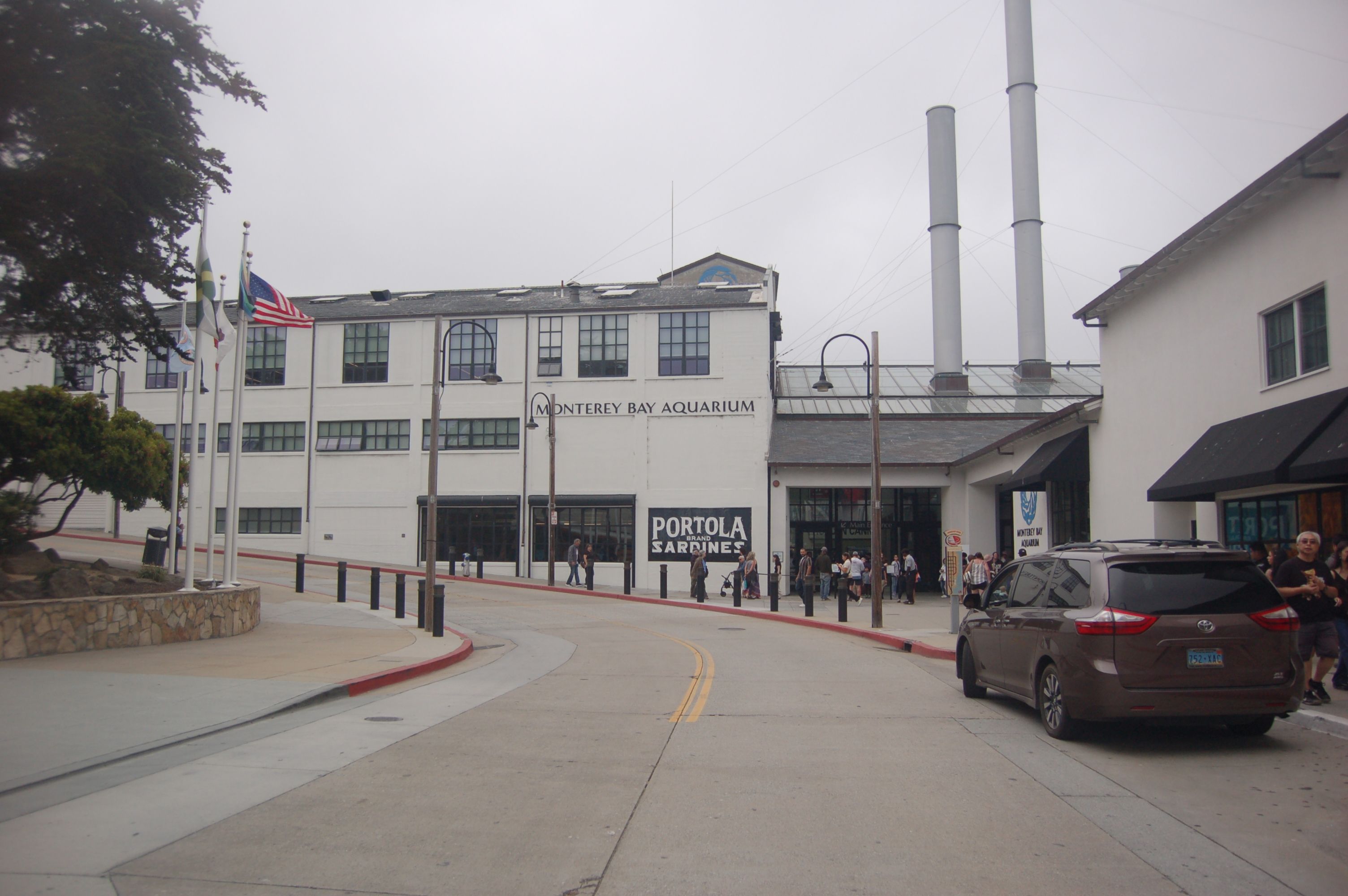
Looking Northwest Along Cannery Row Street, Two Minutes After The Previous Panorama, At The End Of The Street, We Can See The Building Of Monterey Bay Aquarium, Which Is A Historical Preservation Of The Hovden Cannery, A Sardine Cannery, And Is Recognized For Its Architectural Achievement.
…The Front Entrance Is, Below And Slightly To The Left Of, The Two Tall Smoke Stacks.
Wikipedia, With 16 Photos. Click Here. Says =>
…Monterey Bay Aquarium is a nonprofit public aquarium in Monterey, California. Known for its regional focus on the marine habitats of Monterey Bay, it was the first to exhibit a living kelp forest when it opened in October 1984. Its biologists have pioneered the animal husbandry of jellyfish and it was the first to successfully care for and display a great white shark. The organization's research and conservation efforts also focus on sea otters, various birds, and tunas. Seafood Watch, a sustainable seafood advisory list published by the aquarium beginning in 1999, has influenced the discussion surrounding sustainable seafood. The aquarium was home to Otter 841 prior to her release into the wild as well as Rosa, the oldest living sea otter at the time of her death.
…Early proposals to build a public aquarium in Monterey County were not successful until a group of four marine biologists affiliated with Stanford University revisited the concept in the late 1970s. Monterey Bay Aquarium was built at the site of a defunct sardine cannery and has been recognized for its architectural achievements by the American Institute of Architects. Along with its architecture, the aquarium has won numerous awards for its exhibition of marine life, ocean conservation efforts, and educational programs.
Monterey Bay Aquarium receives around two million visitors each year. It led to the revitalization of Cannery Row, and produces hundreds of millions of dollars for the economy of Monterey County. In addition to being featured in two PBS Nature documentaries, the aquarium has appeared in film and television productions.
Founding And Design.
…In the early 1960s, scientists at Stanford University's Hopkins Marine Station grew wary of the growing industry on Cannery Row. The station succeeded in convincing the university of their concerns in 1967, and Stanford University purchased the property on Cannery Row that housed the Hovden Cannery, a sardine cannery on the border of Monterey and Pacific Grove. Hovden Cannery closed in 1973 when its parent company moved the plant, and Hopkins used the facility as a warehouse. In the late 1970s, however, Chuck Baxter and Robin Burnett—both faculty members at Hopkins—along with Nancy Burnett, a graduate of Moss Landing Marine Laboratories, and Steve Webster, faculty at San Jose State University, thought of building an aquarium on the Hovden Cannery site.[c] Three separate proposals for an aquarium in Monterey County had already occurred in 1914, 1925, and 1944, but financial backing and public support for the idea was not sufficient.[2] Nancy Burnett brought the group's interest to her parents, Lucile and David Packard (co founder of Hewlett-Packard), and their foundation commissioned a feasibility study. An aquarium was predicted to attract 300,000 paying visitors annually with a potential future increase to 500,000 so, in April 1978, the Packards created the Monterey Bay Aquarium Foundation, which purchased the Hovden property from Stanford for nearly US$1 million. Around this time, Julie Packard—also a daughter of David and Lucile—joined the planning group. David Packard funded construction with an initial donation of $7 million with the caveat that the private nonprofit would be financially self-supporting after it opened.[d][c] Due to an expansion of its planned exhibits—after visits to public aquariums in Japan—and the design and creation of exhibits in house, the Packards paid a final sum of $55 million.[e][3]
…General contracting firm Rudolph and Sletten predicted the building would take 31 months (two and a half years) to construct, but project manager Linda Rhodes and architectural firm Esherick, Homsey, Dodge, and Davis (EHDD)[e] first had to design the facility to fit Cannery Row. Those involved intended to reconstruct Hovden Cannery rather than destroy it, and EHDD acknowledged that the latter would be "a big disservice to our visiting public and to the community".[f] Concrete sections of the building were able to be kept, but other areas were repurposed; the cannery's old warehouse was converted into administrative offices, and a seawater system for the aquatic exhibits replaced the cannery's pump house that brought fish to the warehouse from floating storage tanks in the bay.[g] The facility was constructed around the cannery's boiler house, which is preserved as a non-functioning public exhibit.[a][h] As the building would reside partially over water, unique challenges occurred throughout construction. Nearly half of the aquarium would be located over the bay in depths of up to 120 ft (37 m), requiring foundational elements to be installed during low tide, which often occurred at night. According to a project manager with Rudolph and Sletten, excavations were sometimes lost as the composition of the ground underneath beach sand was inconsistent.[i]
…Various elements of the building mirrored that of Hovden Cannery, including its windows (to let in sunlight), plain cement walls, structural protection from waves and storms, and its many roofs.[note 1] Exposed pipes and ducts along the ceiling also contributed to the industrial style of buildings on Cannery Row. The ironic transition from a plant that processed fish to an aquarium which would display them did not prevent the facility from appearing like a cannery, according to multiple journalists. The aquarium's successful representation of the cannery was acknowledged by the California Historical Society with a historical preservation award.
File = DSC 0343 Resize602x400
|
|
|
Gallery: Photos Illustrate Pirsig's "Zen Art Motorcycle Maintenance"
Album: In This Photo Album, You Will See Views Of David Matos July 2024 Travel, In San Francisco, CA.
… And Then On Their Way Home To Aiken, SC => Visit Stutter's Fort In Sacramento, CA, Non-Stop Thru Las Vegas & Lake Mead. Photo Time At Bolder Dam (Hover Dam), Plus The REALLY Grand Canyon. & Brief Stop At Meteor Crater:
Album: Album: In This Photo Album, You Will See Views Of David Matos July 2024 Travel, In San Francisco, CA.
… And Then On Their Way Home To Aiken, SC, Visit Stutter's Fort In Sacramento, CA, Non-Stop Thru Las Vegas & Lake Mead. Photo Time At Bolder Dam (Hover Dam), Plus The REALLY Grand Canyon. & Brief Stop At Meteor Crater.
|
|
|


